

There is a specific method for how scientists discover new things or uncover the mysteries of nature and the universe. This method is called the Scientific Discovery Method. It is not a magic formula, but a well-organized and logical process that works step by step. This method helps scientists dispel misconceptions and arrive at accurate information. Its main purpose is to find a reliable explanation of reality through observation and experimentation.

Observation:
The first step in scientific discovery is observation. A scientist becomes curious about a natural phenomenon or subject and observes it closely. It could be the movement of clouds in the sky, the growth of a tree, a chemical reaction, or human behavior. For example, Sir Isaac Newton became curious about the force of gravity after watching apples fall from an apple tree. This observation was the first step in his discovery. The important thing is not to just look, but to look deeply and see if anything unusual is happening.
Formulating Questions:
It is natural to have questions after making observations. These questions are the driving force behind the scientific method. Why does an apple fall? Why does a tree grow in a certain direction? Why does one chemical change color when mixed with another? Questions should be clear and specific, so that they can be answered. A good question guides scientific inquiry in the right direction. The question should be one that can be answered through experimentation. “Does God exist or not?” is a question that does not fall within the scope of the scientific method, because its answer cannot be determined by experimentation.
Forming a Hypothesis:
After the question is formulated, the scientist proposes a possible answer or explanation based on his observations. This possible explanation is called a hypothesis. A hypothesis is not a final truth, it is just an educated guess. It is a statement that can be proven or disproven through experimentation. For example, Newton might have thought: “The Earth has an invisible force that pulls objects toward its center.” This is a hypothesis. When creating a hypothesis, the scientist uses his prior knowledge and logic. The more specific the hypothesis, the easier it is to test.


Experimentation:
Once a hypothesis is developed, it is time to test it. This is the most important step in the scientific method. Experiments are designed to determine whether the hypothesis is proven correct or not. A good experiment must be controlled. This means that the experiment must be designed in such a way that only one variable factor is worked on and everything else remains the same. For example, if you are testing the effect of light on the growth of a plant, the soil, water, and temperature of all the plants will be the same, only the amount of light will be different. Careful data collection is required during the experiment. This data can be both quantitative or qualitative.
Analyzing Data and Drawing Conclusions:
The data obtained from the experiment is carefully analyzed. In this step, statistics and logic are used to see whether the data supports or rejects the hypothesis. If the data supports the hypothesis, it is stronger. And if it doesn’t, then the hypothesis is proven wrong. Being proven wrong doesn’t mean failure. Rather, it’s an opportunity to learn something new and create a new hypothesis. Sometimes scientists change their hypothesis and design new experiments. Based on this analysis, a decision is made – was the hypothesis correct, or was it incorrect, and why?
Communicating and Reviewing Results:
The final step in scientific discovery method is publication. Scientists publish their research, methods, results, and conclusions in scientific journals, which allow other scientists to peer review their work. This is very important, because other scientists can verify the results by doing the same experiment or explore deeper by creating new questions. This process continuously enriches scientific knowledge. Errors are corrected and new ideas are developed.
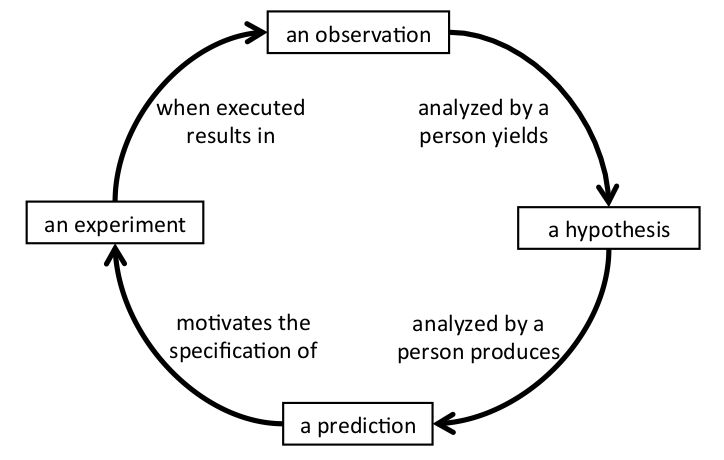
In short, the scientific discovery method process is: Observation → Questioning → Hypothesis → Experimentation → Data Analysis and Decisions → Publication of Results. It is a cyclical process, where a discovery often raises new questions and leads to further exploration. This approach has made science trustworthy and reliable, because it relies on scrutiny and evidence. This is not a rigid recipe, but rather a flexible framework that can be adapted to different research areas.


Conclusion:
Thus the scientific discovery method functions as a continuous, logical, and self-correcting process. It is not only a path to acquiring new knowledge, but also a powerful tool for deeply understanding the world around us. Scientists are prone to making mistakes, but this method ensures that mistakes are caught and corrected. Each new discovery not only answers a question, but often creates more questions, which gives scientific exploration a constant momentum. This is the beauty of science – not standing still but constantly moving towards truth, which is the key to the progress and prosperity of mankind.